
Healthy Cooking Oils
The Empowered Health Team
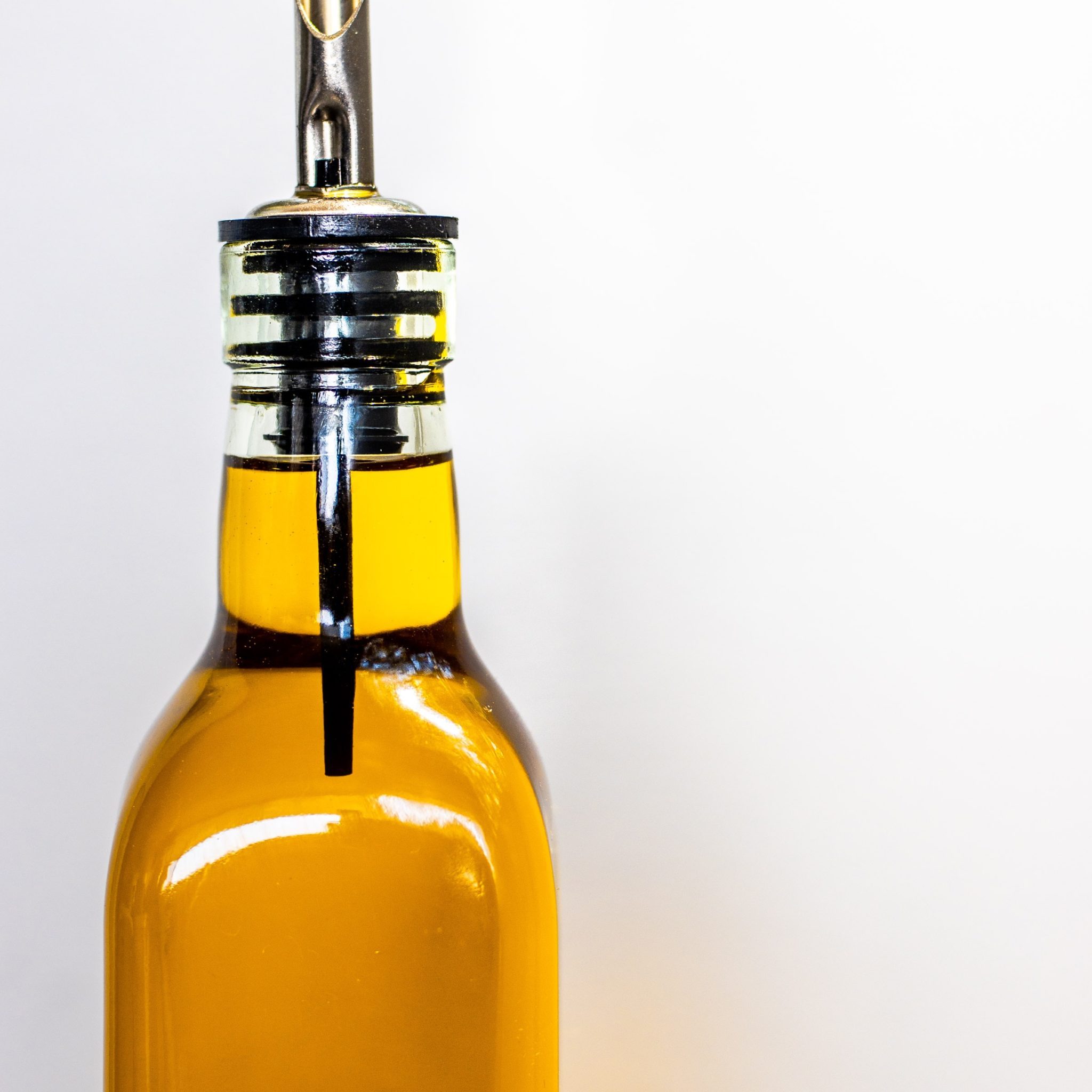
A good cooking oil is an important part of any recipe. Not only do they have their own health benefits, but they can also help to enhance flavor, nutritional quality, and influence the overall feel of the food. They can also have an influence on the quality of certain cooking techniques.
When it comes to cooking with oils, though, it is important to pick the right one. The key factors that can influence the quality of an oil include:
- How they’re made
- Smoke point
- Fatty acid composition
Ideally, you want to use an oil that is in its natural state or minimally processed, has a higher ratio of saturated to unsaturated fats, and a smoke point that is well above the temperature you plan to cook at.
But why?
Fatty Acid Composition. The ratio of the saturated to unsaturated fatty acids (the fatty acid composition) matters because the more saturated fatty acids in the oil, the more stable it is, and the less likely it is to break down and oxidize with prolonged exposure to air. When oils are exposed to air, primarily the oxygen in air, they can break down producing free radicals (atoms that are unstable and are linked to cell damage that can lead to disease, cancer, or premature aging).
However, it is the unsaturated fats, which contain polyunsaturated and monounsaturated fatty acids, that have been shown to be beneficial to a heart healthy diet. Keeping your exposure to saturated fats to a minimum can go a long way toward keeping your cholesterol in check. For this reason, it is recommended to use cooking oils that are high in saturated fats minimally. These include butter, ghee, and coconut oil.
Another factor that should be taken into account is the types of unsaturated fatty acids, in particular the ratio of omega-6 to omega-3 fatty acids. This matters because although our body needs omega-6 fatty acids, eating a diet high in this form is linked to increased inflammation. In contrast, a diet high in omega-3 fatty acids can reduce inflammation (3,4). Cooking oils that are high in omega-6 fatty acids should be used sparingly and include corn, soybean, safflower, sunflower, and canola oils.
Smoke Point. If your cooking oil has a smoke point that is lower than the temperature you will be cooking at, this will lead to diminished nutritional quality and could give your food an unpleasant flavor (1,3). More importantly, when a cooking oil is heated beyond its smoke point, it can also convert the fatty acids into those harmful free-radicals we mentioned before (1,3).
How they are made. Cooking oils can be processed in multiple ways. When they are extracted using chemical methods, the oil is referred to as refined. This is usually done to purify the oil, neutralize the flavor, and filter it of any unwanted particles. This may sound great, but can lead to conditions (heat and oxidation) that result in modifying the fatty acids into less nutritional forms.
When non-chemical methods are used, cooking oils are referred to as unrefined. In general, these are minimally processed and are less likely to be oxidized from exposure to air, heat, or other chemicals. For this reason, it is recommended to look for organic, unrefined, cold-pressed or expeller pressed oils as the main choices in your kitchen.
Other things to keep in mind:
How you store your cooking oils. It is also important to note that how your cooking oils are stored is important. The biggest dangers to oil are ultraviolet light, heat, and exposure to air (or oxygen). For these reasons, it is recommended to store all cooking oils in a sealed glass bottle in a cool dark place. For all but coconut oil, an opaque container is recommended to protect them from degradation caused by sunlight.
Use of generic vegetable oils. It can be difficult to know exactly which vegetables went into the creation of the oil. This makes it difficult to know the fatty acid composition and to be able to determine the smoke point. They also tend to be more highly processed.
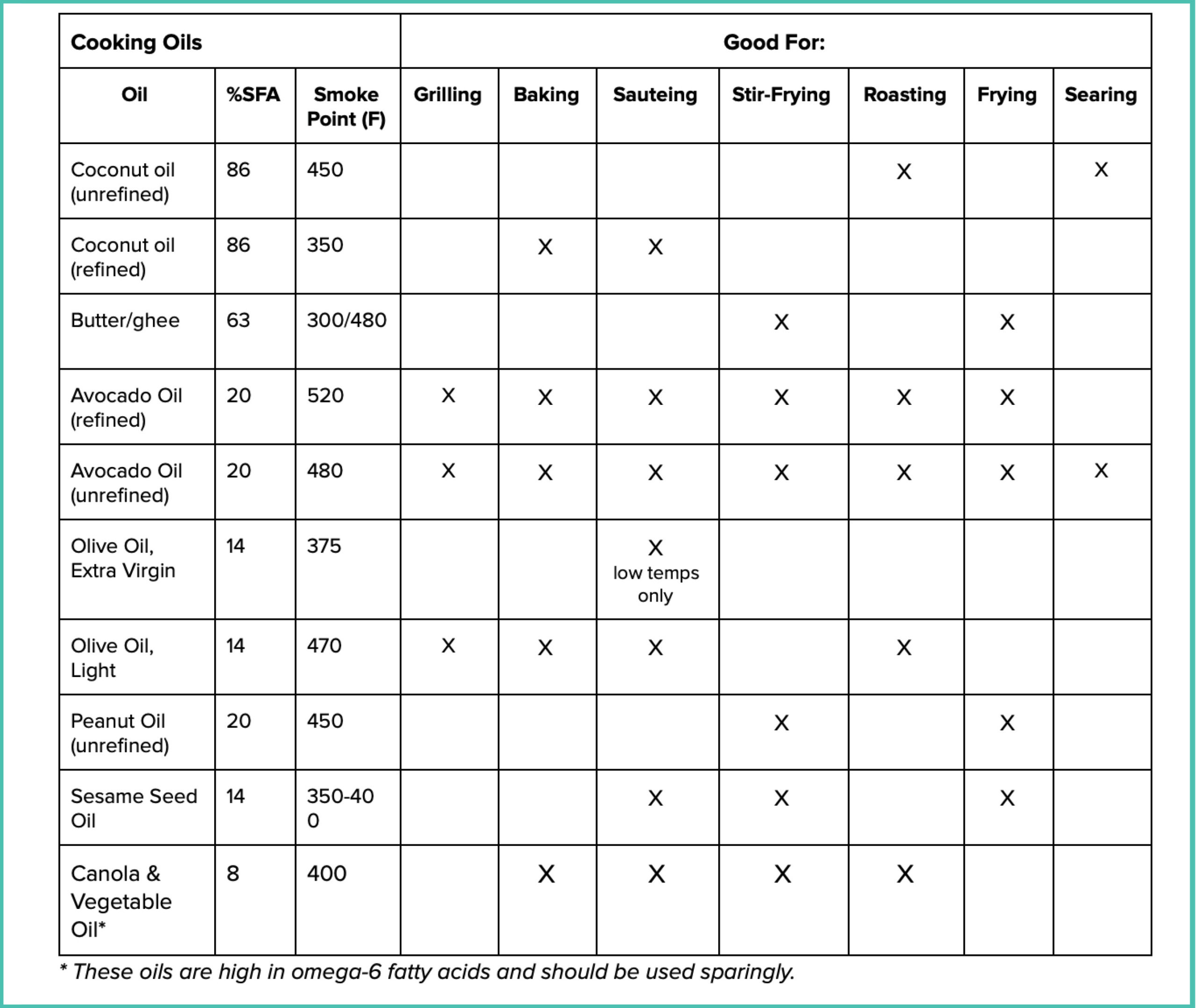
The following table can be used as a quick reference for which oil to use for the type of cooking you are looking to do. If an oil isn’t listed in the table, it’s a good assumption that you probably should use it only for dressings or to add flavor to your food after it has been cooked.
- https://www.healthline.com/health/health-benefits-cooking-oil-guide#Cooking-oils:-Health-benefits,-smoke-points,-and-best-uses
- https://www.mayoclinic.org/healthy-lifestyle/nutrition-and-healthy-eating/expert-answers/cooking-oil/faq-20058170
- https://www.bendbulletin.com/lifestyle/health/cooking-oils-which-is-right-for-you/article_2278dbbf-f14a-5c2f-a34e-26c5f7bd7b49.html
- https://drhyman.com/blog/2016/11/18/heres-determine-healthiest-fats-cook/
We are here to answer your questions.
Schedule your Health Coaching Inquiry Call today!
Our Health Coaching Inquiry call is a 20-minute phone call with our certified health coach to answer any of your questions regarding these services.
* This is not a medical consultation in any way.