
Building Strong Foundations for Lifelong Health

May is one of the most powerful months to pause and reflect on what truly shapes our long-term health.
With national themes centered around mental health and bone health, this is an opportunity to zoom out and ask a bigger question:
What are you doing today that will impact how you feel 10, 20, even 30 years from now?
As a physician, I often see patients when something feels “off”, whether it is fatigue, weight changes, poor sleep, or increased stress. But what’s often underneath those symptoms is a pattern that has been building quietly over time.
The good news? That pattern can be changed.
Mental Health Is Whole-Body Health

Mental health is not just about mindset, it’s deeply connected to physiology.
When you’re under chronic stress, your body produces higher levels of cortisol, a hormone designed to help you respond to short-term stress. Over time, elevated cortisol can lead to:
-
Disrupted sleep
-
Increased abdominal fat
-
Blood sugar instability
-
Hormonal imbalance
This is what we refer to as chronic stress physiology and it affects far more than your mood.
Bone Health: A Silent Process You Can Influence
Osteoporosis is often thought of as something that happens later in life.
In reality, bone density begins to decline much earlier, especially for women as estrogen levels begin to shift.
Bones are living tissue. They respond to how you move, eat, and live.
You reach peak bone mass around age 30. After that, the goal is to maintain as much as possible.
What Strengthens Bone:
-
Resistance training
-
Adequate protein intake
-
Vitamin D and magnesium
What Weakens Bone:
-
Sedentary lifestyle
-
Chronic stress
-
Poor nutrition
Movement: Not All Exercise Is Equal
Walking is excellent for cardiovascular health, but it’s not enough to maintain bone density.
Bones require mechanical load, meaning resistance or impact, to stay strong.
This is why strength training is one of the most powerful tools for long-term health.
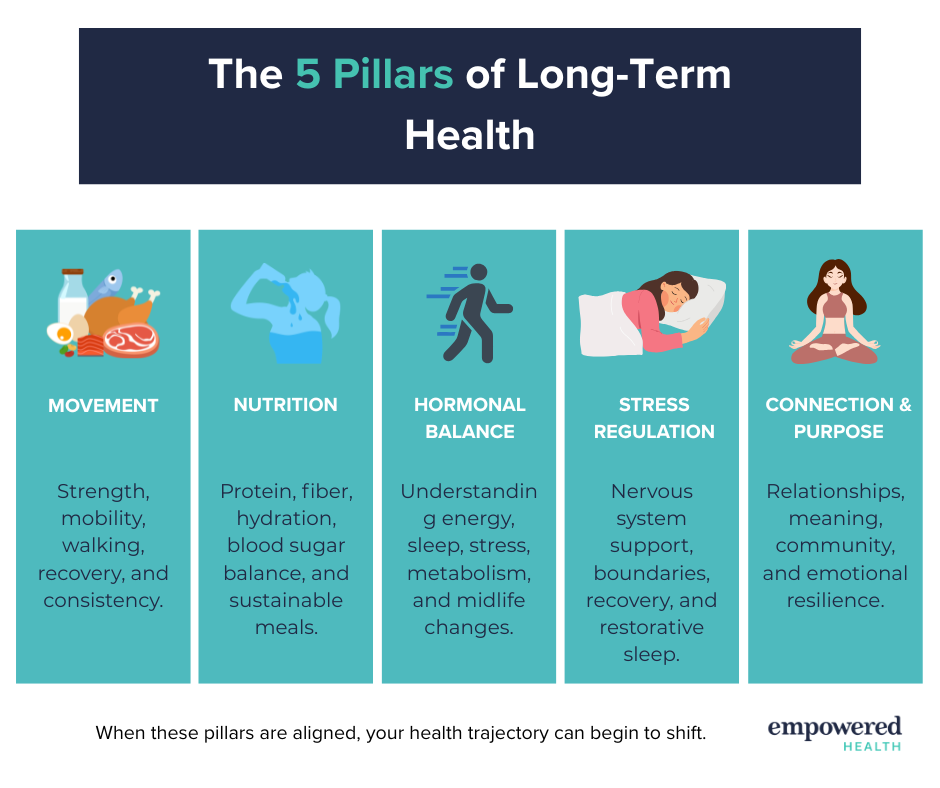
A Patient Story
A mid-40s patient came in feeling “just off.”
She was sleeping poorly, gaining weight despite eating well, and feeling increasingly overwhelmed.
Her labs showed early metabolic changes, elevated cortisol patterns, and subtle hormonal shifts.
Nothing was “diagnosed”, but everything was trending in the wrong direction.
Through personalized care, targeted nutrition, strength training, and stress support, she began to feel like herself again.
Not because we treated symptoms, but because we addressed the root cause.
Health is not built in a single decision, it’s built through patterns.
The body is constantly adapting to what you do repeatedly.
When those patterns shift, your biology shifts.
Bringing It Back to You
Whether it’s stress, bone health, or energy, these are not isolated issues.
They are signals.
And when you begin to understand those signals, you can change your path forward.
You don’t need a complete overhaul to change your health.
You need consistent, intentional actions that support your body over time.
If you’re ready to take a more proactive, personalized approach to your health,
Schedule an inquiry call to learn more.
Because your future health is being built by what you do today.A

Empowered Health Institute
Why Empowered Health.
Time between patient and physician is dictated increasingly by the health system and insurance reimbursement. At Empowered Health, we take a membership approach to primary care in Tri-Cities that challenges the standard healthcare model.

Five Most Important Areas of Men's Health
Subscribe to our series, "Optimizing Men's Health" for information on the top five areas men need to pay attention to TODAY to promote and improve their longevity.